Sponsored By GenealogyBank

22 March 2015
Before Visiting Cemeteries on Private Property
Smaller rural cemeteries present a variety of research challenges, particularly in terms of access. Not all of these small cemeteries are publicly accessible--some may be located on private property. Access will require the permission of the landowner and that person should be contacted some time before any planned visit. Local historical or genealogical societies may also have copies of earlier transcriptions which may have been done when stones were more legible and may be able to help determine the current owner of the property on which the cemetery is located.


21 March 2015
Other Blog Update List
Periodically I send out email updates about genealogical events, summaries of popular blog posts, announcements, webinars, and other items--separate from the postings to this blog and with email addresses kept in a separate list and not sold, shared, traded, etc.-just like the emails on this blog.
If you'd like to receive these updates--subscribe via this link. You can easily unsubscribe to this update and announcement email without giving up your subscription to this blog. That's why the emails are kept on a separate list.
Using this separate list allows us to focus this list on it's genealogical content. If you want to receive the announcements, subscribe. If you want to just keep getting the posts to this blog, do nothing.
Thanks!
Pittsburg, PA is Plattsburgh, NY
Locations in records can easily be off more than one might expect. A relative born near Plattsburgh, New York is listed on a passenger manifest as being born in Pittsburg, Pennsylvania.
It's easy to see how Pittsburgh and Plattsburgh could be confused if the writing is messy. And, if the clerk is in a hurry he may have paid no attention to the "NY" and the "PA."
It's easy to see how Pittsburgh and Plattsburgh could be confused if the writing is messy. And, if the clerk is in a hurry he may have paid no attention to the "NY" and the "PA."
From GenealogyBank--Our Sponsor

20 March 2015
Check the Inventory Before You Search
Some online databases like to "tease" users with titles that indicate the database is more encompassing than it actually is. Make certain you know what a database contains before searching it. The title may indicate that the marriage records are from 1800-1920, but there may be a twenty year gap of missing records in the mid-1800s.
Of course, that will be the twenty year time span you actually need.
Of course, that will be the twenty year time span you actually need.
19 March 2015
Did They Go Back Across the Pond?
Immigrants did not always stay in their new country. Some were not happy and ended up returning to their homeland. If you can't find where your immigrant ancestor died in their "new country," consider the possibility that they went home and never returned.
Using Bureau of Land Management and Fold3.com Presentations
Using the Bureau of Land Management Site
This presentation discusses search strategies for the Bureau of Land Management website--which hosts a database of federal land patent extracts and images. It will include a brief discussion of legal land descriptions in federal land states before discussing the several ways the site can be searched and queried. The presentation will conclude with several specific examples and how the site was queried for additional information. $7 includes presentation and handout.
Navigating Fold3.com-Wednesday
Frustrated with finding databases and people on Fold3.com? This presentation discusses search techniques for determining what Fold3.com has, what it doesn't and how to search the entire site and specific databases for individuals of interest. Download complete presentation for $7.
18 March 2015
A Chicken in Every Picture

Are there clues sitting there? Clues that you never noticed because your research skills were not as developed? Clues that you didn't realize were clues because you didn't know much about the family? Clues that you didn't notice because you simply overlooked them?
The chicken is this picture wasn't crucial to my research, but it reminded me that it never hurts to take another look.
17 March 2015
Tombstone Tales
Just about anything can appear on a tombstone--not just the dates of birth and death. Some immigrants had their place of birth inscribed on their tombstone and others may have included military service information. Any information on a stone should be compared to other sources, but never assume that the "stone won't tell me anything I don't already know."
15 March 2015
Are They the Same Person?
It's hard to write a "quick tip" or set of rules for making certain that two records refer to the same person. There are many variables to consider when deciding that two people in different records are the same person. That said, here are some things to think about when trying to determine if two records actually refer to the same person:
- are the names reasonably similar?
- are the ages consistent?
- is the occupation and lifestyle consistent?
- are you not violating the laws of physics or biology?
- are the locations reasonably consistent?
Think before you conclude that two people in different sources are the same person. Don't just assume that they are.
14 March 2015
Duplicate Record Copies?
Were duplicate copies of vital records being kept when that vital record was recorded? In some locations during some time periods, vital records may have been recorded at the local and state level. While they are supposed to be "the same thing," one may be more legible than another (especially if carbons were used), easier to access, cheaper to obtain, etc.
13 March 2015
Did Someone Come Over Later?
If you are having difficulty tracing your 18th century immigrant "back across the pond," determine if he or she had cousins, nephews, nieces, or other relatives who immigrated later. Relatives who immigrated later may have left behind better documentation of their origins across the pond.
12 March 2015
Anyone Can Forget Their Age
When analyzing an age for a relative given in a document, remember that a person can easily be "off" on their age by several years, especially if they are providing the information "off the cuff" or are not thinking clearly when providing it.
And they may never have dreamed that a century later, their descendant would analyzing that age and wondering why it's a few years "off."
And they may never have dreamed that a century later, their descendant would analyzing that age and wondering why it's a few years "off."
11 March 2015
1925 Iowa State Census
If any relative lived in Iowa in 1925, make certain you have found them in the state census taken that year. It asked a variety of personal questions, including names of parents.
10 March 2015
Do You Work Without Maps?
When you get all "into" researching a person or family in an area that is unfamiliar to you, do you stop and take the time to find maps of the areas where the people of interest live? It is important to know county, state, and other boundaries and the relative proximity of the places where you think people live. It's even more imperative in a "new" area where the geography may be unknown to you.
Don't assume you "know" the geography "good enough" or that the states are small enough that it doesn't matter. Look at maps. Analyze locations. Determine how far apart different residences for your ancestor are.
Don't get so caught up in the search that you lose sight of the geography in the process.
Don't assume you "know" the geography "good enough" or that the states are small enough that it doesn't matter. Look at maps. Analyze locations. Determine how far apart different residences for your ancestor are.
Don't get so caught up in the search that you lose sight of the geography in the process.
09 March 2015
Pursuing the Purpose and Process
When you are using a record with which you are unfamiliar, make certain you learn something about the "purpose and process" of the record. Failing to do so, make result in you interpreting the information incorrectly. Marriage bonds, marriage banns, and warnings out are three good examples of things that sometimes are not quite understood.
And finding one obscure blog post via a Google search isn't always adequate.
And finding one obscure blog post via a Google search isn't always adequate.
Webinars 10 March-Bureau of Land Management and Brick Walls
My BLM and Brick Wall Strategies webinars are tomorrow-10 March. Still time to join us.
08 March 2015
Where Are You Dating?
An 1890 era family genealogy indicated an ancestor died after 10 April 1811. No source or reason for the date is given. Apparently one genealogist, also without giving a source, decided to use that as the death date. So now an unsourced "dead by date" has become an unsourced death date.
Indicate where you obtained material and make certain you don't indicate something says more than it does.
Or you could be correcting the error forever.
Indicate where you obtained material and make certain you don't indicate something says more than it does.
Or you could be correcting the error forever.
07 March 2015
Who Is the Connection?
A relative moved from central Massachusetts to central Vermont around the turn of the 18th century to a location where he had no relatives and where none of his relatives settled. When I discovered the maiden name of his wife, I realized that the family he moved with from Massachusetts to Vermont with were not his biological relatives but biological relatives of his wife.
Are you looking for the connection on the wrong side of the family?
Are you looking for the connection on the wrong side of the family?
06 March 2015
Repeated Names?
In some time periods and cultural groups, using names of deceased children for later children was not uncommon. Families could easily have three children with the same name. A Geske born in 1746 who died in 1748 could have been the first of that name. Another Geske born in 1749 who died in 1749 could have been followed by a third child with that name born in 1751.
Our Sister Site: Genealogy Search Tip of the Day
Genealogy Search Tip of the Day is different from Genealogy Tip of the Day. The Search Tip of the Day site briefly mentions websites, online databases, and online search techniques and reminders. Genealogy Tip of the Day (this site and blog) focuses on research methods, terminology, interpretation, and pitfalls but doesn't often mention websites. To get the Search Tip of the Day in your email, visit http://genealogysearchtip.blogspot.com/.
Search Tip of the Day does not always come out daily.
Search Tip of the Day does not always come out daily.
Exploring Our Sponsor's Offerings
05 March 2015
No Middle Name
In some locations and some time periods, it was not common to use middle names. Do not assume that your ancestor had a middle name. It is possible that he or she did not.
Historical USGS Maps
Historical USGS maps are available online. For those who have not seen them, a recent post on Rootdig has a sample image and a brief discussion.
The maps can be viewed here: http://historicalmaps.arcgis.com/usgs/
The maps can be viewed here: http://historicalmaps.arcgis.com/usgs/
What Genealogy Tip of the Day Is and Is Not
For those who are new, Genealogy Tip of the Day is usually one daily genealogy research tip. To help pay the bills, we do occasionally mention our sponsor, GenealogyBank, or activities in which I am involved. That's it.
We don't post general genealogy event announcements here, don't announce products or publications, and don't distribute press releases via the Tip of the Day mailing list. There are other venues for those publications and announcements. This is not one of them.
All tips are "self-generated," usually as I'm doing actual research. For that reason, we will have similar tips from time to time and sometimes topics will seem to be mentioned in "spurts" if I'm working on a certain project. Also for that reason tips probably won't mention locations or records with which I'm not familiar (my incomplete ancestor table is here). I rarely write tips on whatever is "trending" just to get more traffic. That's just how we roll.
Suggestions are always welcome!
And, as always, thanks for your support of Genealogy Tip of the Day. It is appreciated--please let your genealogy friends know about us! Thanks.
We don't post general genealogy event announcements here, don't announce products or publications, and don't distribute press releases via the Tip of the Day mailing list. There are other venues for those publications and announcements. This is not one of them.
All tips are "self-generated," usually as I'm doing actual research. For that reason, we will have similar tips from time to time and sometimes topics will seem to be mentioned in "spurts" if I'm working on a certain project. Also for that reason tips probably won't mention locations or records with which I'm not familiar (my incomplete ancestor table is here). I rarely write tips on whatever is "trending" just to get more traffic. That's just how we roll.
Suggestions are always welcome!
And, as always, thanks for your support of Genealogy Tip of the Day. It is appreciated--please let your genealogy friends know about us! Thanks.
04 March 2015
We Are Leaving Instantly!

That means "this month" and is sometimes abbreviated "inst."
03 March 2015
Are You Doing Unit Searches?

The Quincy Whig-Republican posted this item in June of 1865 that the 78th Illinois was headed back to Illinois to be paid off.
Of course muster out dates and pay dates are part of an ancestor's military record, but this reference (which was likely copied on other papers) may have been how family members knew their loved one's unit was headed home.
You can search for your ancestor's unit on GenealogyBank among other sites.
02 March 2015
Was He Mixed Up With His Brother or His Son?
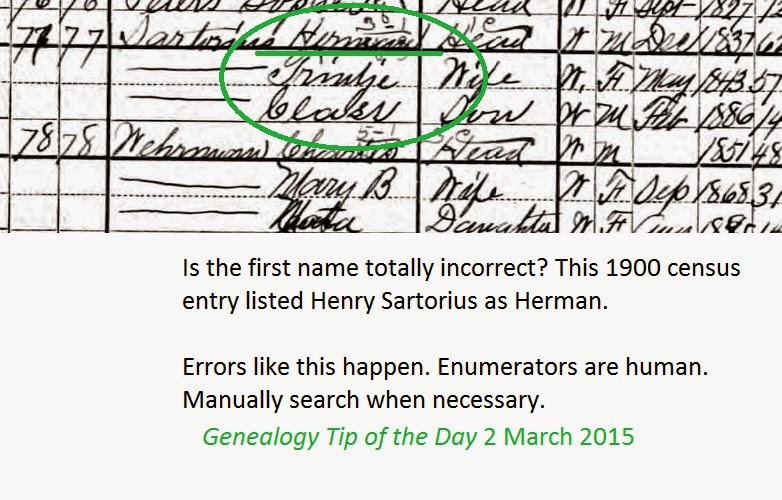
The census enumerator may have confused Henry with his son of the same name--or perhaps his late brother. Both men were named Herman.
Henry's middle name was Ameling, so that doesn't explain the error.
Sometimes people just get one or two things mixed up. It happens.
Situations like this are one time when a manual search of the record itself or a last name only search of the database may be necessary.
01 March 2015
Webinars: Brick Walls, BLM, Fold3, and Research Process
The week of 9 March, we're offering webinars on the following topics:
- Using Fold3.com
- Using the Bureau of Land Management website
- Brick Wall Strategies for 2015
- Is Your Strategy the Problem?
Want to join us? More details are here.
Did the Missing "Heir?"
If there is a relative who went "poof," have you determined if at any point in time they were an heir to an estate? That relative you cannot locate after 1900 may have an interest in a 1920 estate that mentions their whereabouts.
28 February 2015
What Obituaries Leave Out
Family written obituaries provided to newspapers can leave out as much as they include. Previous spouses may not be included, children can be left out, which spouse was the parent of which surviving children may not be clear, individuals listed as children may not be biological children. One relative of mine had an obituary that did not list his three children by a first marriage and only listed three of his four living children with his second wife.
And that survivor, Fluffy--it may be a cat even if it is not stated as such.
And that survivor, Fluffy--it may be a cat even if it is not stated as such.
27 February 2015
Spelling Irregularities are a Necessary Evil
Variations in how your ancestor's name was spelled can be endlessly frustrating. However, it's worth remembering that a variation of how your ancestor's name appears in an index can arise from a variety of situations:
- Your ancestor did not know how to spell his name
- Your ancestor could not read
- Your ancestor did not speak clearly
- Your ancestor had an accent with which the writer of his name was unfamiliar
- The clerk didn't care
- The clerk had bad writing
- The transcriber could not read the name
- The transcriber did not care
- The transcriber made a typographical error
- The document has faded over time and is difficult to read
- Or something else
Keep in mind that one of more of these could explain why James Rampley ends up indexed as Jarvis Pample.
26 February 2015
A Lost Mockingbird

John Tucking lost his mockingbird in 1866 and advertised for its return in the Daily Illinois State Journal.
Don't gloss over those search results from the classifieds. They may contain a little plumage you can add to your ancestor.
-----------------------
Genealogy Tip of the Day is sponsored by GenealogyBank. Check out their current offer for Tip of the Day fans/followers/readers.
Do Statewide Reports Mention Your Ancestor?

Graduates of state-sponsored schools may be mentioned in reports of this type. State schools for the deaf, blind, etc. also may have submitted reports.
Items such as these are increasingly being put online on sites such as Google Books, Archive.org, etc.
Genealogical Seminar in Birmingham, Alabama-28 March 2015
I will be the speaker at the Alabama Genealogical Society's Spring Seminar on Saturday, March 28 at Samford University in Birmingham. Topics will include 'Tried and Tested Tidbits', 'Researching the Entire Family', 'Organizing Online Research', and 'I Found It – Now What?'. Registration flyer is posted the Society's website at http://algensoc.org/main/seminars.html
Tip of the Day fans are welcome to attend!
Tip of the Day fans are welcome to attend!
Subscribe to:
Posts (Atom)